Now That the AI Actually Works: What Smarter Hospital Equipment Means for Moving It
AI-enabled devices and surgical robots are now standard hospital equipment. Here is what that changes about relocating, delivering, and installing them, and why white-glove logistics is now a clinical decision.
For about a decade, "AI in healthcare" was mostly a conference slide. That stopped being true. The FDA's list of AI-enabled medical devices has passed roughly 1,500 authorizations, the large majority of them in radiology, and the surgical robotics market is tracking around $10.6 billion in 2026. The AI is no longer in the pitch deck. It's in the CT scanner, the OR, and the hallway cart.
Which creates a problem almost nobody plans for until the week of the install: the equipment got smarter, heavier, more fragile, and far more expensive to have sitting still.
This is a logistics post, not a medical one. But if you run a hospital, an imaging center, a surgical center, or a multi-site practice, the two are now the same conversation.
What changed on the floor
Three shifts matter for anyone who has to physically move this equipment.
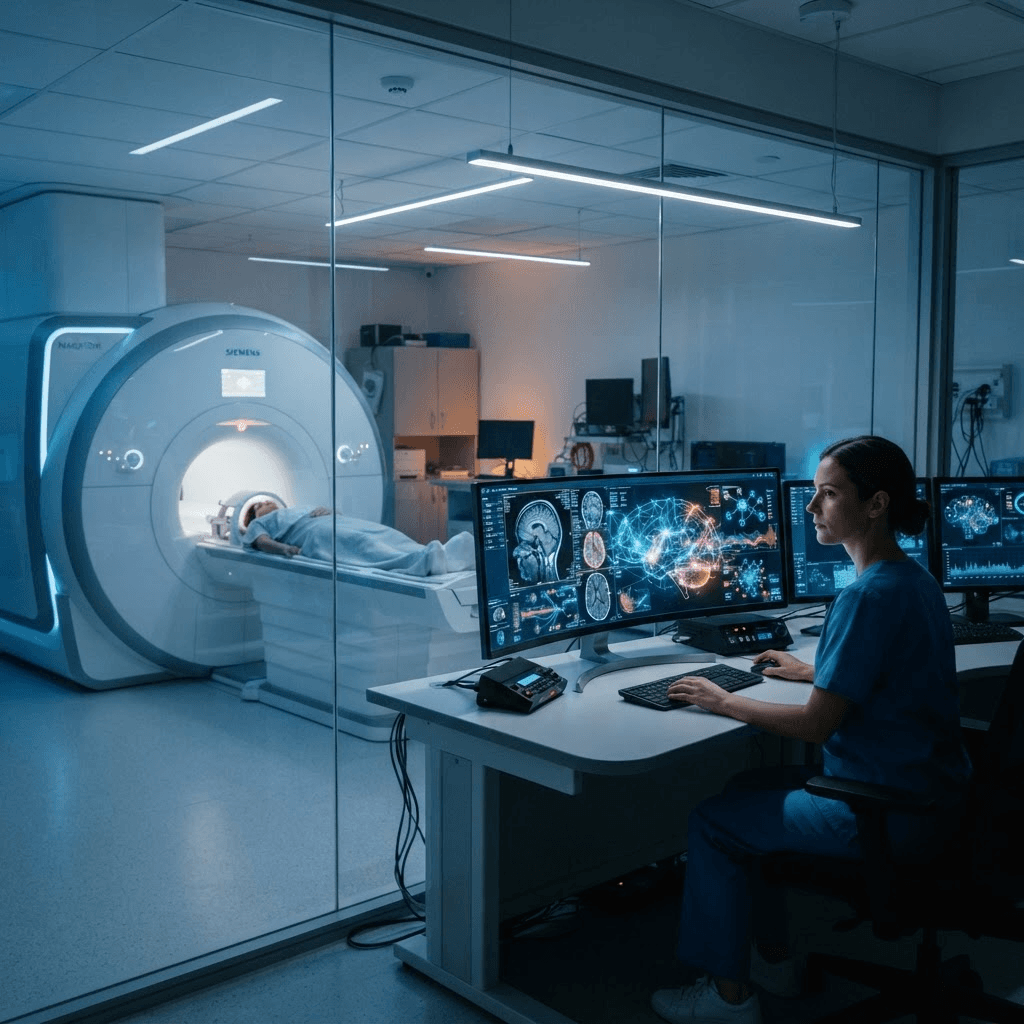
1. Imaging got AI-native. Deep-learning reconstruction is now standard on new MRI and CT platforms - the scanner produces cleaner images from shorter scans because software is doing work the magnet used to do alone. Practically, that means facilities are replacing perfectly functional 8- and 10-year-old scanners early to get throughput gains. More replacements means more de-installs, more rigging, and more outgoing units headed to resale or storage instead of scrap.
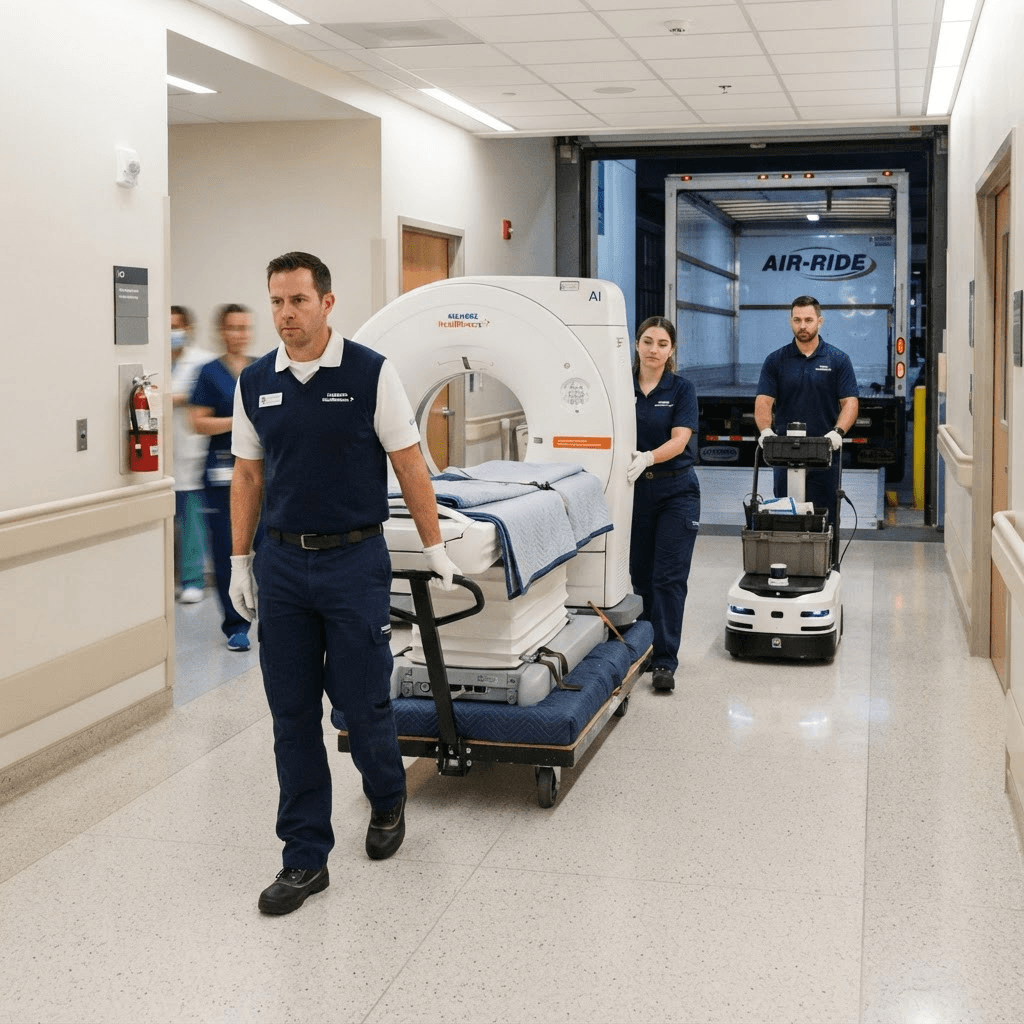
2. Robots moved out of the OR. Surgical platforms are the headline, but the quieter change is autonomous mobile robots doing supply runs, linen, lab specimens, and medications. They are compact, battery- and sensor-dense, and they get relocated between units constantly as hospitals work out where they actually pay off.
3. Point-of-care devices got a brain. AI-enabled ultrasound, portable X-ray, cardiac monitors, and retinal cameras now ship with onboard inference. They look like the equipment you have always moved. They are not. A bump a 2015 portable ultrasound would have shrugged off can knock a calibrated sensor array out of spec on a 2026 unit.
Why the freight side has to change with it
Most of this equipment still gets shipped the way a pallet of office chairs gets shipped: LTL, dock to dock, multiple terminals, three transfers, a liftgate, and a driver whose job ends at the door.
That worked when the failure mode was a scratched panel. It does not work now, for four reasons.
Downtime costs more than the shipping ever will. A single MRI or CT suite generates meaningful revenue per scanning hour, and backfilling the schedule is brutal - patients do not reschedule neatly. A scanner that arrives Thursday instead of Tuesday is not a two-day delay, it is a two-week hole in the schedule. Measured against downtime instead of against another carrier's quote, expedited stops looking expensive very quickly.
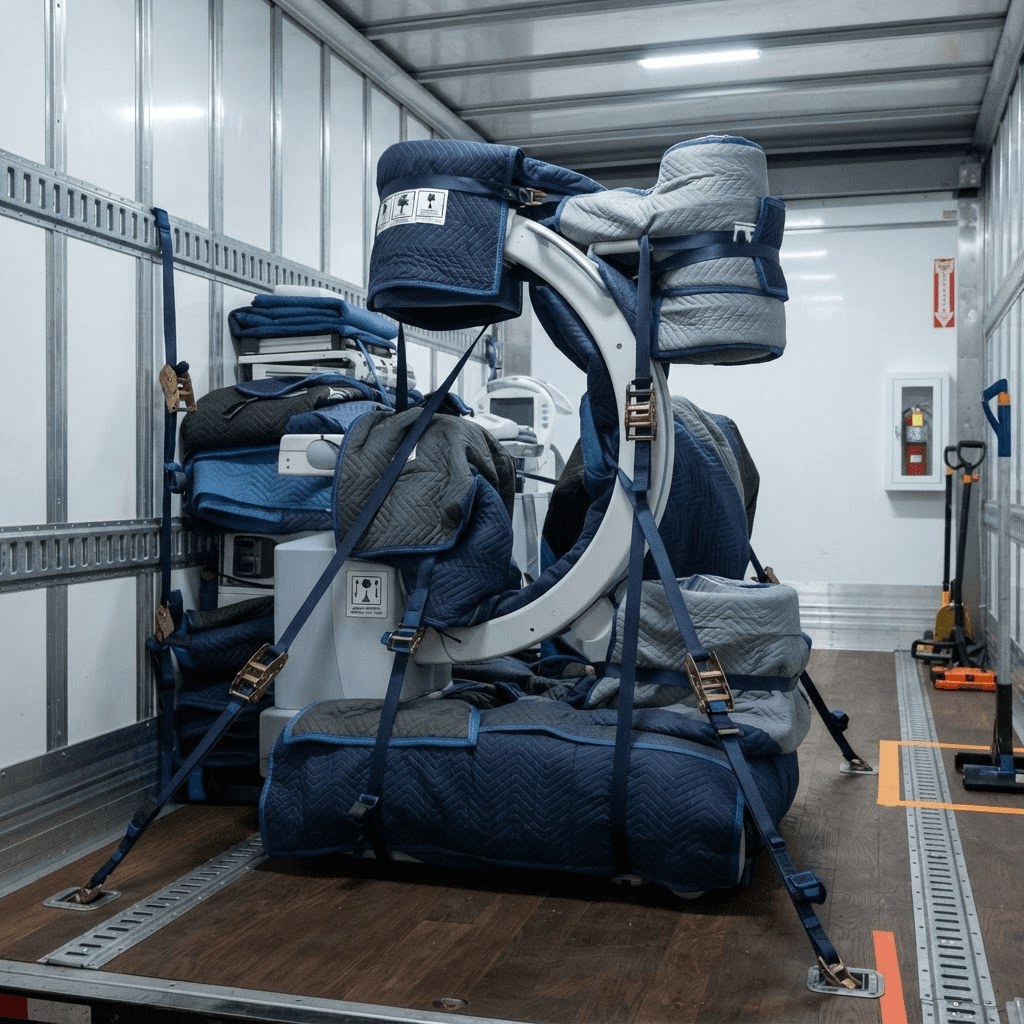
Calibration is the real cargo. With AI-enabled imaging and sensor-dense robotics, you are not just transporting hardware, you are transporting a calibrated state. Shock, vibration, tilt, and temperature swings can all cost you that state, and the failure is invisible at delivery. Nobody finds out until the physicist runs QA or the first patient is on the table.
Install is not delivery. Somebody has to get it through the door, around the corner, into the room, onto the pad, and connected. Curbside drop-off on a $1.4M asset is a non-event that creates a week of problems. Inside delivery, debris removal, uncrating, positioning, and OEM install coordination are the job, not add-ons to the job.
Chain of custody is now a compliance question. Devices with onboard storage and network connectivity land inside your security and HIPAA posture. Who touched it, when, where it sat overnight, whether it was ever unattended - those answers need to exist. A terminal-to-terminal LTL lane cannot produce them.
What hot shot actually means here
Hot shot logistics is straightforward: one dedicated vehicle, one load, direct from pickup to delivery. No terminals, no consolidation, no re-handling.
For medical equipment, the direct route is not about speed for its own sake. It is about eliminating the events where damage happens. Every transfer between trucks is a lift, a re-strap, and a forklift operator who does not know what is in the crate. Remove the transfers and you remove most of the risk. The speed is a byproduct.
That is the model RapidMed runs: dedicated single-load vehicles, live GPS and dispatch updates, white-glove crews trained on medical assets, and a rapid-response fleet on standby 24/7, because equipment failures do not schedule themselves.
A short checklist before your next install or relocation
If you have a piece of AI-enabled equipment or a robot moving in the next 90 days, get answers to these before you book anything:
- What is the actual path? Door widths, elevator capacity, turn radii, floor loading, and the pad or bay it has to land on. Measure it, do not trust the drawing.
- Who uncrates and positions it? Name the party. If the answer is "the carrier, probably," you do not have an answer.
- Who coordinates with the OEM installer? Delivery windows and install windows have to be the same conversation, or you pay for a tech to stand in an empty room.
- What are the environmental limits in transit? Temperature and humidity ranges, shock thresholds, orientation requirements. Get them from the manufacturer in writing.
- What is the de-install plan for the outgoing unit? Old equipment does not disappear. Resale, trade-in, storage, or disposal - decide before the new unit is on the dock.
- What is the downtime cost per day? Once you have this number, every other logistics decision gets easy.
The short version
The AI finally works, and it arrived inside machines that are heavier, more sensitive, and more expensive to leave idle than anything that came before. Treating their transport as commodity freight is a habit from an era when equipment was simpler and downtime was cheaper. Neither is true anymore.
If you have a scanner, a robot, a lab build-out, or a full department relocation coming up, the freight plan should be written at the same time as the clinical plan, not the week before delivery.
See more jobs like this on our Facebook page (opens in a new tab)
Equipment down? We roll now.
24/7 hot shot dispatch, same-day pickup across VA, MD, DC and NC, national and international white-glove delivery.