Hospital Logistics Company vs. General Freight Carrier: Why the Difference Shows Up on Delivery Day
A general freight carrier and a hospital logistics company are not the same thing. Here is where the difference shows up, and when each one makes sense.
On paper, a general freight carrier and a hospital logistics company both pick something up and drop it off somewhere else. The quotes can even look alike. The difference does not show up on the rate sheet. It shows up on delivery day, when a unit either rolls into the right room ready to use, or sits on a dock with a bent corner and nobody to bring it upstairs.
Here is a fair comparison of the two, including the jobs where ordinary freight is perfectly fine.
Two different business models
A general freight carrier is built to move a lot of freight at a low cost per pallet. That means combining many shippers on one trailer and routing it through a network. A hospital logistics company is built around the item itself: one load, handled by people who know what it is, going where it needs to go inside the building.
Neither model is wrong. They are designed for different things, and trouble starts when one is used for the other’s job.
The route: terminals and rehandling versus going direct
Most general freight moves as LTL, less than truckload. Your shipment is picked up, taken to a terminal, unloaded, sorted, loaded onto another trailer, and may repeat that at more terminals before final delivery. Each transfer is another forklift, another dock and another chance for a hard bump.
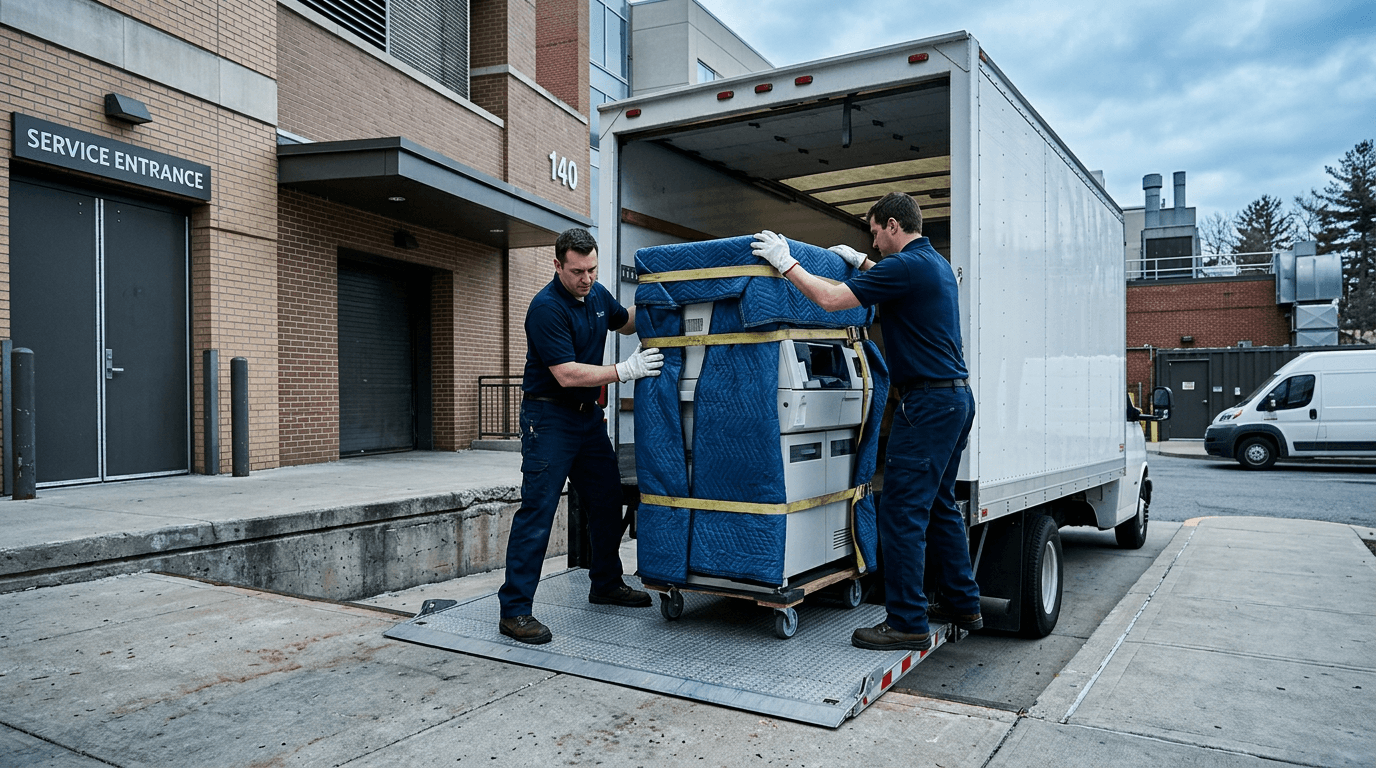
A hot shot run works differently. The unit goes on a truck and stays on that truck from pickup to delivery. No terminal stops, no cross-docking, no sharing space with someone else’s pallets. For fragile or calibrated equipment, fewer touches is the whole point.
The last fifty feet: curbside versus placement
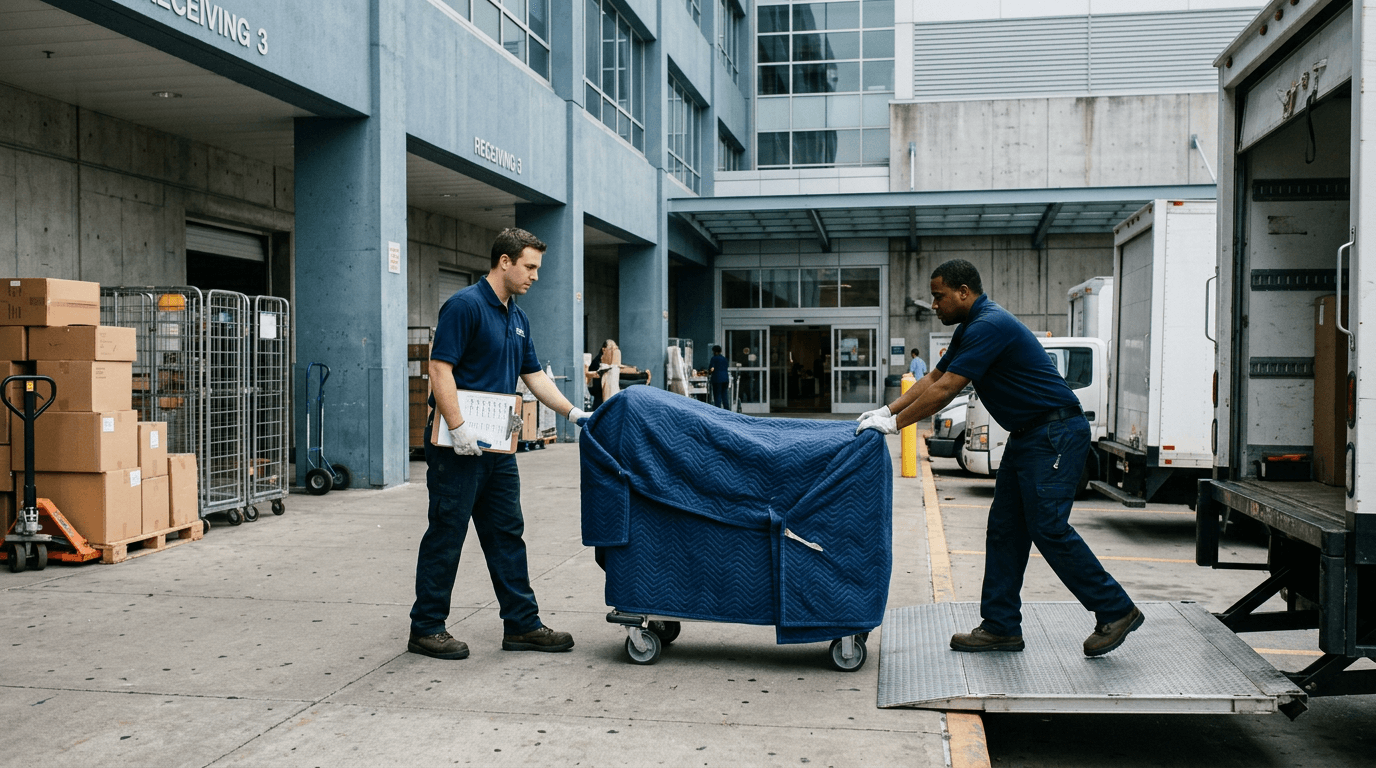
Standard freight delivery usually ends at the dock or the curb. Inside delivery, if offered at all, is an add-on with limits. With a hospital logistics company, getting the unit into the room is the job, not an extra. That includes unwrapping it, setting it where clinical staff want it and taking the packing away.
Working inside a clinical building
A hospital is not a warehouse. A crew working inside one has to respect how it runs:
- Dock schedules. Hospital docks handle food, linens, pharmacy and supplies on tight windows. Arriving outside your slot can mean waiting or being turned away.
- Elevators. Service elevators are shared with patient transport and environmental services. Crews need to coordinate, not take over.
- Clean corridors. Some hallways and units have rules about what can pass through and how it must be covered.
- Quiet hours. Inpatient floors may restrict noise and traffic at certain times.
Side by side
Here is how the two compare on the points that matter most to a hospital:
| Factor | General freight carrier | Hospital logistics company |
|---|---|---|
| Routing | Through terminals with transfers | Direct, one truck from pickup to delivery |
| Handling | Forklifts and shared trailers | Hand-handled, wrapped and strapped |
| Delivery point | Dock or curb | Inside the building, placed in the room |
| Building rules | Not part of the job | Dock windows, elevators and corridors planned for |
| Best for | Boxed supplies on pallets | Sensitive, heavy or calibrated equipment |
When general freight is the right call
Be honest about the load. Boxed supplies on shrink-wrapped pallets, like gloves, paper goods, packaged disposables and similar items, travel fine through an LTL network. They are built to be stacked and forklifted, nobody needs them placed in a specific room, and the lower cost makes sense. Paying for a dedicated truck there is usually money you do not need to spend.
When it is not
Switch to a hospital logistics company when the load includes:
- Imaging equipment such as C-arms, ultrasound and portable X-ray units. See how to move a C-arm safely.
- Lasers with optics and articulated arms that do not tolerate shock.
- Lab analyzers that must stay upright and arrive ready for service.
- Anything calibrated, where a rough ride means a service call before the unit can be used.
A quick test before you book
If you answer yes to any of these, general freight is probably the wrong fit:
- Would a hard bump mean a service call or recalibration?
- Does the unit have to stay upright the whole trip?
- Does it need to go past the dock into a specific room?
- Is there a hard deadline for it to be in place?
- Would damage take a department or procedure room out of service?
Where RapidMed Logistics fits
RapidMed Logistics provides 24/7 hot shot medical equipment logistics with white-glove inside delivery and placement. We offer same-day pickup across Virginia, Maryland, Washington DC and North Carolina, and next-day delivery is available. Our regional hospital logistics guide explains how that coverage works. Look through our services, the equipment we move and our locations, then get a quote for the load that should not go through a terminal.
Frequently asked questions
- What is the difference between LTL and hot shot delivery?
- LTL shipments share a trailer with other freight and move through terminals, often with several transfers. A hot shot run keeps your load on one truck from pickup to delivery.
- Can I ship boxed medical supplies with a general freight carrier?
- Usually, yes. Palletized, boxed supplies are built for freight networks. A hospital logistics company makes more sense for sensitive, heavy or calibrated equipment that needs inside placement.
- Does RapidMed Logistics deliver inside the building?
- Yes. White-glove inside delivery and placement is part of what we do. Call 866-216-7742 or request a quote online.
See more jobs like this on our Facebook page (opens in a new tab)
Not sure which one your load needs?
Tell us what it is and where it is going. Call dispatch 24/7 at 866-216-7742 or request a quote online.