How to Choose the Best Hospital Logistics Company: A Buyer's Checklist
The best hospital logistics company is the one that moves medical equipment every week, brings the right handling gear, delivers inside to the room, answers the phone at 2 a.m., and puts insurance and condition reports in writing. Everything else is marketing.
Search for a hospital logistics company and most results say the same things: fast, careful, reliable. Those words are easy to print and hard to check. This checklist gives supply chain, facilities, biomed and clinical engineering teams a way to compare vendors on the things that actually decide whether a move goes well.
It covers what hospital logistics includes, what to check before you hand over a piece of equipment, the questions to ask on the first call, and the warning signs that tell you to keep looking. At the end, we show where RapidMed Logistics fits so you can judge us by the same standard.
What does a hospital logistics company actually do?
Before you compare vendors, be clear about the work. Hospital logistics is not one service. Most health systems need some mix of these, and a company that is strong at one may be weak at another:
- Equipment delivery. New or refurbished units coming from a vendor, warehouse or another facility and going into a specific room.
- Moves between facilities. Shifting a monitor, bed, ultrasound or analyzer between campuses, clinics and outpatient sites.
- Department relocations. Moving a whole lab, imaging suite or clinic floor on a schedule that keeps patient care going. See planning a hospital department relocation.
- Urgent and time-critical runs. A unit fails and a loaner, replacement or part has to arrive before the schedule falls apart.
- Removals, storage and returns. Clearing out retired equipment, holding units between sites, and routing trade-ins, returns and decommissioned assets. See hospital equipment removals and medical device warehousing.
Ask each vendor which of these they do regularly, not just which they are willing to try. If you only need one of them, pick the company that does that one every week.
Why does medical-only experience matter so much?
A company that moves furniture on Monday and lab analyzers on Tuesday is learning on your equipment. Medical gear has its own rules: devices that must stay upright, arms and gantries that need transport locks, screens and probes that crack under pressure, and systems that the manufacturer must de-install before anyone touches them.
Ask a vendor what medical equipment they moved recently and how they prepared it. Specific answers about specific devices, like how they secured a C-arm or protected ultrasound transducers, mean they have done it. Vague answers about "all kinds of freight" mean they have not. Our guides on how to move a C-arm safely and how to ship an ultrasound machine show the level of detail you should hear.
What handling equipment should the truck and crew bring?
Care depends on what is on the truck when it arrives, not what is in the brochure. Ask what the crew brings for a job like yours:
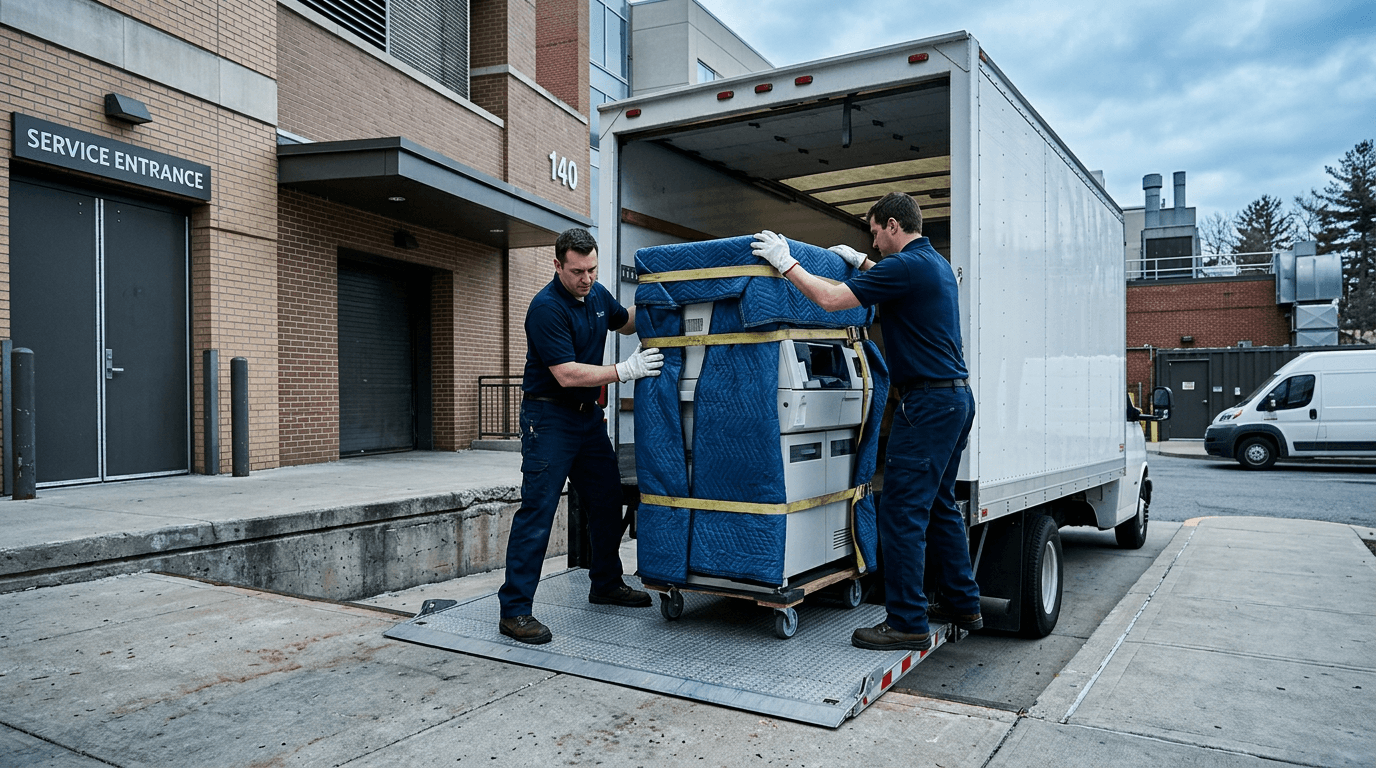
- Liftgate. So heavy units come down to the ground under control instead of off a dock edge.
- Air-ride suspension. It softens road shock and vibration for sensitive electronics, optics and imaging components.
- Padding and blankets. Enough to fully wrap screens, panels and corners, with extra for accessories.
- Strapping and load bars. To keep a unit from shifting, rocking or tipping in transit.
- Dollies, pallet jacks and ramps. Sized for the weight of your equipment, not a sofa.
- Climate control when needed. For electronics, reagents and anything sensitive to heat, cold or humidity.
Does the quote include inside delivery and room placement?
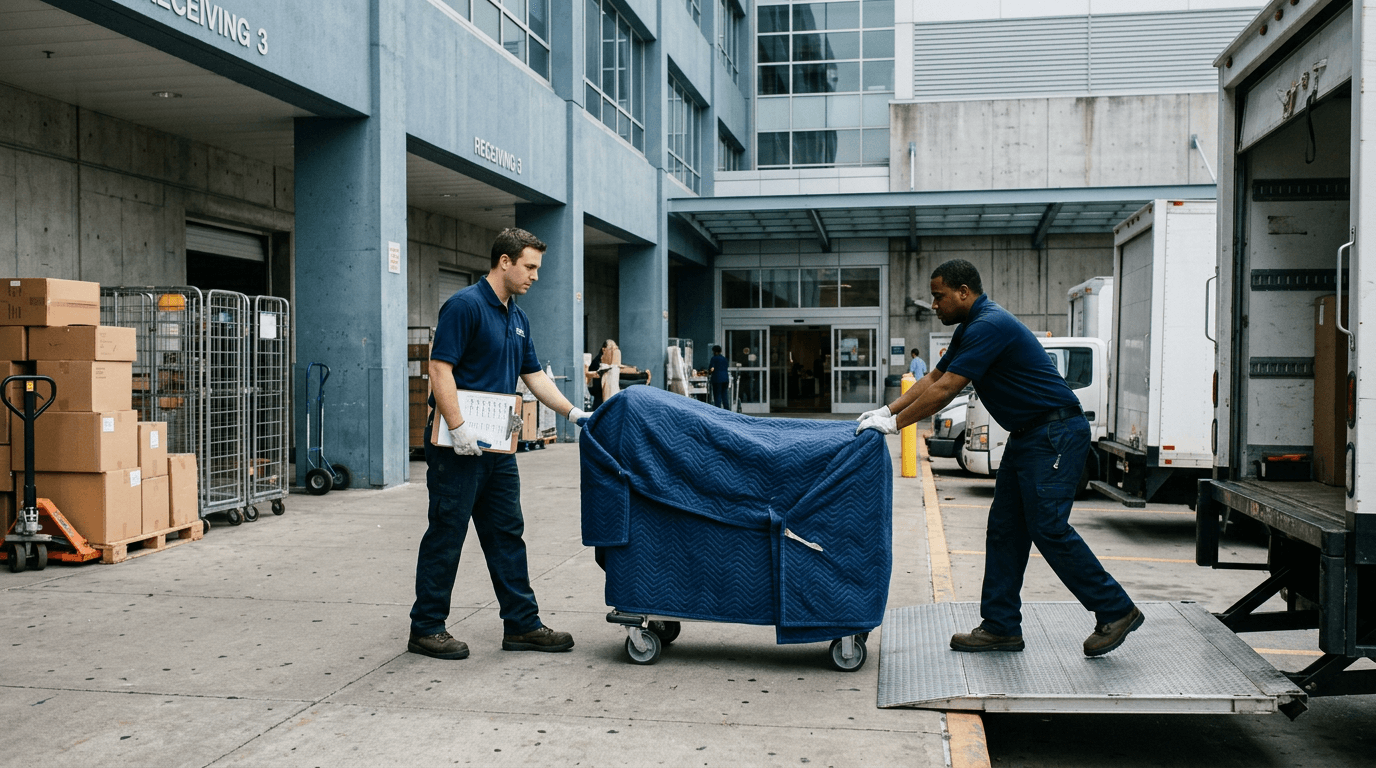
Many carriers define delivery as the moment the freight touches your dock. For a hospital, that is where the hard part starts. Someone still has to bring the unit through the building, onto the right elevator, down the right corridor and into the right room, then unpack it and haul away the packing.
Get the delivery definition in writing. If the quote says "dock to dock" or "curbside," your staff will be doing the last and riskiest part of the move themselves. A true white-glove service includes inside delivery, room-of-choice placement, uncrating and debris removal. Read what white-glove delivery actually means for the full list.
Is a hospital logistics company better than a general freight carrier?
For boxed supplies on pallets, a general freight carrier can be fine. For equipment, the difference is in the handoffs. General freight usually means shared trailers, terminal transfers and dock delivery. A medical logistics company runs dedicated trucks direct from pickup to delivery and brings a crew that knows how to handle and place the unit.
The fewer times your equipment is loaded and unloaded, the fewer chances it has to be damaged. We cover the trade-offs in detail in hospital logistics company vs. general freight carrier.
What happens when you call after hours?
Equipment does not fail on a schedule. Ask what happens when you call at night, on a weekend or on a holiday. Does a person answer, or a voicemail box? Can they dispatch a truck right then, or only take a message for the morning?
For time-critical medical logistics, that answer matters more than almost anything else on this list. A vendor that can only help during business hours cannot help when a replacement is actually urgent. Test it: call the number on their website after 6 p.m. and see who picks up.
What insurance and documentation should you ask for?
Ask for a certificate of insurance before the first job and check that the coverage fits the value of what you are moving. Standard carrier liability is often limited by weight, which can be far below the value of a medical system.
Then ask how the vendor documents condition and custody. A good carrier notes and photographs the unit at pickup and again at delivery, keeps a chain-of-custody record of who handled it and when, and uses a bill of lading that lists every piece. If something is wrong, you have a record instead of an argument.
Will you have one point of contact, and do they cover your sites?
When a move goes sideways, you want one person who knows the job, not a call center that has to look it up. Ask who you will talk to from quote to delivery, and whether that person can make decisions.
Then check coverage against your real addresses. A vendor near your main campus may still be far from your outpatient clinics or your vendor’s warehouse. Look at their service locations and ask about each address you use, including whether same-day pickup is available there.
Do they work with your OEM and biomed team?
Many imaging, lab and surgical systems must be de-installed and re-installed by the manufacturer or a certified biomedical engineer. The logistics company does not replace that work, but it should fit around it: arriving when the engineer finishes, using the OEM’s shipping locks or crates, and delivering in time for the re-install appointment.
Ask how the vendor coordinates with OEM field service and in-house biomed. Our guide to hospital logistics for biomed and clinical engineering explains what that coordination looks like.
The buyer’s checklist
Use this list when you compare vendors side by side:
- Moves medical equipment regularly and can describe recent jobs
- Runs dedicated trucks, not shared freight with terminal transfers
- Brings a liftgate, air-ride suspension, padding and proper strapping
- Includes inside delivery, room placement and debris removal in the quote
- Answers and dispatches after hours, weekends and holidays
- Provides a certificate of insurance before the job
- Documents condition and chain of custody at pickup and delivery
- Coordinates with your OEM and biomed team
- Gives you one named contact for the whole move
- Covers every facility address you need served
Want more questions for the first call? See 12 questions to ask a hospital logistics company.
What red flags should end the conversation?
- They cannot say who will actually be driving your load.
- The load gets passed to another carrier you never spoke to.
- The quote only covers dock to dock.
- No one can explain how they protect a screen, arm or probe.
- Insurance paperwork is "on the way" and never arrives.
- They promise a delivery time before asking where the unit is or what it is.
Where RapidMed Logistics fits
We are a 24/7 hot shot medical equipment logistics company. Here is what we offer against the checklist above:
- Dedicated hot shot vehicles, direct point-to-point with no terminal stops. See same-day hot shot medical equipment delivery.
- White-glove inside delivery and placement with 2 and 3 person crews, not a curbside drop.
- Same-day pickup across VA, MD, DC and NC, with national and international service. See our hospital logistics guide for Virginia, Maryland, DC and North Carolina.
- Installation coordination with your OEM or biomed team, plus storage and reverse logistics.
- Dispatch 24/7 at 866-216-7742.
See our medical device logistics services, the equipment we move and our locations, or get a quote and ask us every question on this list.
Frequently asked questions
- What should I look for first in a hospital logistics company?
- Start with medical experience. A company that regularly moves medical equipment already knows how to prepare, protect and place it. Then check handling gear, inside delivery, after-hours dispatch, insurance and coverage.
- Is inside delivery included with most carriers?
- Often it is not. Many freight quotes stop at the dock or curb. Ask for the delivery definition in writing so you know whether the crew will bring the unit to the room and remove the debris.
- What is the difference between hospital logistics and regular freight?
- Regular freight usually means shared trailers, terminal transfers and dock delivery. Hospital logistics uses dedicated trucks direct from pickup to delivery and a trained crew that places the equipment in the room.
- How do I test whether a logistics company really offers 24/7 service?
- Call their main number at night or on a weekend. A real 24/7 dispatch has a person answer who can send a truck, not a voicemail box that takes a message for the morning.
- Does RapidMed Logistics offer same-day pickup?
- Yes, across Virginia, Maryland, Washington DC and North Carolina, with national and international service. Call 866-216-7742 or request a quote at https://www.medicalequipmentlogistics.net/quote.
See more jobs like this on our Facebook page (opens in a new tab)
Put us through the checklist.
Call dispatch 24/7 at 866-216-7742 or request a quote with your pickup and delivery details, and ask us anything on this list.